Condition Guide · Sheffield Vein Clinic
Varicose Veins in Sheffield
Aching, swollen or visibly bulging veins in your legs? You are not alone — and effective, minimally invasive treatment is available at Sheffield Vein Clinic, led by Prof Steve Goode, NHS Consultant Interventional Radiologist.
Consultant-Led Assessment
Prof Goode performs every initial consultation personally
Duplex Ultrasound Included
Accurate diagnosis at your first appointment
No GP Referral Needed
Send your enquiry directly to Sheffield Vein Clinic
Evidence-Based Care
NICE-recommended treatments throughout
Transparent Pricing
Full cost confirmed before any treatment
Do You Recognise These Symptoms?
Varicose veins affect an estimated one in three adults in the UK — and the symptoms go well beyond the veins you can see.
Many people put up with their symptoms for years, assuming the condition is purely cosmetic or that nothing can be done. But varicose veins are often more than a cosmetic concern — and modern treatment is significantly more straightforward than most patients expect.
- Visible bulging or rope-like veins on the legs or calves
- Aching, heaviness or fatigue in the legs — especially after standing
- Ankle and foot swelling that builds through the day
- Itching or burning sensation over the affected vein
- Skin discolouration or thickening around the lower leg
- Leg cramps or restless legs — particularly at night
If you are based in Sheffield, South Yorkshire or the surrounding areas — including Chesterfield and the Peak District — a consultant assessment at Sheffield Vein Clinic on Ecclesall Road can provide a clear diagnosis and a straightforward path to treatment.
What Causes Varicose Veins?
Understanding the root cause is the first step to lasting treatment — not just covering the symptoms.
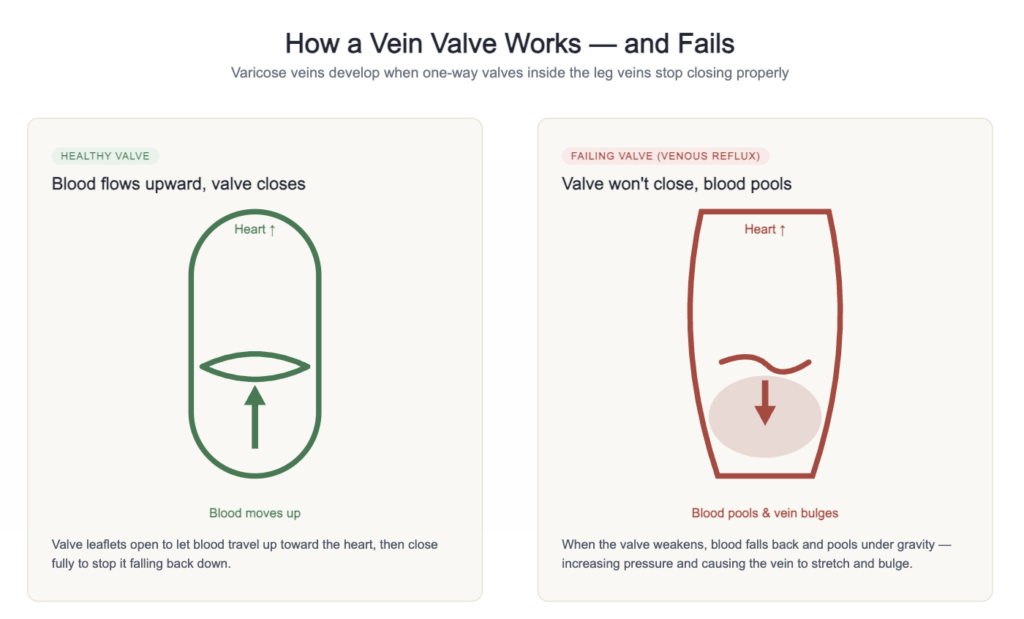
Varicose veins develop when the one-way valves inside the leg veins fail to close properly — a condition known as venous reflux disease. In a healthy venous system, these valves open to allow blood to travel upward toward the heart, then close to prevent it falling back down. When a valve weakens, blood pools in the vein — increasing pressure and causing the vessel wall to stretch and bulge.
This is why treating only the visible varicose vein without identifying and addressing the underlying valve failure often leads to recurrence. Accurate diagnosis starts with mapping where the reflux is occurring — which requires duplex ultrasound assessment.
Several factors increase the likelihood of varicose veins developing:
- Genetics — a family history is the strongest single risk factor
- Prolonged standing — healthcare, retail, teaching and hospitality
- Pregnancy — raised blood volume and hormonal changes place added strain on veins
- Age — vein valves naturally weaken over time
- Obesity — increased abdominal pressure impairs venous return
- Previous DVT — deep vein damage can cause secondary varicose veins
Key Point
Treating the visible vein without identifying the underlying valve failure is a common cause of varicose vein recurrence. Duplex ultrasound assessment by Prof Goode maps the source of reflux before any treatment is recommended.
How Are Varicose Veins Diagnosed at Sheffield Vein Clinic?
A clinical examination alone cannot tell the full story. Accurate diagnosis requires duplex ultrasound.
Duplex ultrasound is the diagnostic gold standard for varicose veins and the underlying venous reflux that causes them. It combines real-time imaging of vein anatomy with Doppler technology to measure the direction and velocity of blood flow — revealing exactly where valves have failed and which segments of the venous system are diseased.
The pattern of reflux directly determines the most effective treatment. Recommending the right approach requires knowing precisely which veins are affected and to what extent.
At Sheffield Vein Clinic, duplex ultrasound is performed personally by Prof Steve Goode at every initial consultation. He maps the venous anatomy directly — in the same appointment — and uses this to inform his treatment recommendation on the day.
For patients across Sheffield, South Yorkshire and the surrounding region, this level of consultant-performed assessment is available at our Ecclesall Road clinic — without a GP referral and typically within days of contacting us.
- Identifies which veins have failing valves — great saphenous, small saphenous, perforators
- Maps the full extent of reflux from groin to ankle
- Measures vein calibre to determine the best treatment modality
- Assesses the deep venous system and excludes post-thrombotic changes
Why Varicose Veins Should Be Assessed — Not Ignored
Varicose veins are progressive. Without treatment, the underlying venous pressure continues to build — and the consequences can go well beyond cosmetics.
Not every patient will develop complications — but early assessment generally means simpler procedures and better long-term outcomes.
C1–C2 · EARLY
Early Stage
Cosmetic thread veins and small varicose veins. Aching or heaviness after long days. Often dismissed — but this is the ideal time for assessment and, if appropriate, treatment.
C3–C4 · MODERATE
Moderate Stage
Prominent varicose veins with consistent leg swelling. Increasing discomfort affecting daily activity and quality of life. Treatment remains straightforward.
C4–C5 · ADVANCED
Advanced Stage
Skin changes around the lower leg — discolouration, hardening (lipodermatosclerosis), venous eczema. The skin is becoming damaged by sustained venous hypertension.
C6 · COMPLICATED
Complicated Stage
Venous leg ulcers — open wounds that fail to heal without treating the underlying venous disease. Clinical evidence strongly supports early venous intervention to accelerate healing.
Early assessment and treatment — when disease is less advanced — generally results in simpler procedures and better long-term outcomes.
Treatment Options for Varicose Veins in Sheffield
Modern varicose vein treatment is minimally invasive, highly effective and performed as an outpatient procedure at Sheffield Vein Clinic.
The appropriate treatment will depend on the anatomy identified at duplex ultrasound — the size and location of the diseased vein, the extent of reflux, and the distribution of varicose tributaries. Prof Goode will recommend the most effective approach at your consultation.
EVLA — Endovenous Laser Ablation
The gold-standard treatment for significant varicose veins caused by venous reflux. A laser fibre seals the diseased vein permanently from within — under ultrasound guidance. No general anaesthetic. No surgical incisions. Walk-in, walk-out.
Foam Sclerotherapy
A medical foam is injected into the varicose vein under ultrasound guidance, causing it to collapse and fade. Used for medium-sized varicose veins and as part of a combination approach.
Combination Therapy
For many patients, the best long-term outcomes are achieved by combining EVLA for the main incompetent vein with foam sclerotherapy for remaining tributaries. Planned around your anatomy.
Why See Prof Steve Goode for Varicose Veins in Sheffield?
NHS Consultant Interventional Radiologist. Newly appointed Professor. The specialist who sees you — and treats you — personally.
Prof Steve Goode is a Consultant Interventional Radiologist at Sheffield Teaching Hospitals NHS Trust and newly appointed Professor — bringing NHS subspecialty expertise in image-guided vascular procedures to his private practice at Sheffield Vein Clinic on Ecclesall Road.
Interventional Radiology is the specialty that pioneered the minimally invasive, ultrasound-guided endovascular techniques now used as the gold standard in vein treatment. Prof Goode is also research-active, with ongoing academic work in vascular imaging. His clinical practice is informed by current evidence — not historical protocols.
Sheffield Vein Clinic serves patients across Sheffield, Rotherham, Barnsley, Chesterfield, Doncaster and the wider South Yorkshire region. No GP referral is required.
- Duplex ultrasound performed personally by Prof Goode at your first consultation
- Varicose vein treatment performed personally — not delegated
- NHS Consultant and Professor — research-active, evidence-based practice
- Full range of treatments available at Sheffield Vein Clinic
- Continuity of care — the same consultant throughout your treatment course
- Transparent pricing — see our pricing page before you commit
Varicose Veins — Frequently Asked Questions
Answers to the questions patients in Sheffield most commonly ask before requesting their assessment.
Get a Clear Answer About Your Varicose Veins
A duplex ultrasound assessment with Prof Steve Goode will tell you exactly what is causing your varicose veins — and what, if anything, needs to be done about it.
Sheffield Vein Clinic is based at 772–774 Ecclesall Road, Sheffield — accessible from across South Yorkshire, North Derbyshire and the Peak District. No GP referral required. Appointments typically available within days.